
Candyland Casino Complaints, Reputation and Red Flags
 Available in GB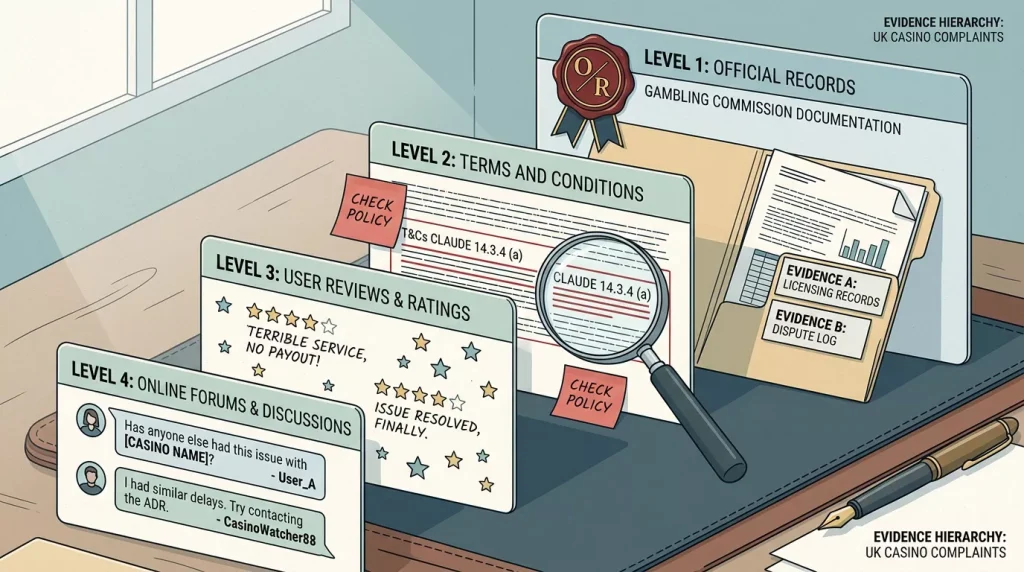
Candyland Casino complaints and review scores should be treated as signals, not proof. UK readers should compare the exact domain, official terms, licence status, withdrawal rules, KYC requirements, complaint patterns and credible third-party sources before making any decision. A positive review average does not confirm UK regulatory protection, and a single negative post does not prove misconduct. The safer approach is evidence weighting: give most weight to official terms and regulator records, then use review platforms and forums only to identify patterns that need checking.
Why complaints research needs evidence weighting
Casino reputation pages can become misleading when they repeat unverified allegations or turn affiliate praise into certainty. Candyland Casino is especially important to assess carefully for UK readers because Candyland’s UK licensing has not been independently verified for this reputation guide. That does not prove the site is unavailable, but it means readers should not assume the same protections, dispute routes or self-exclusion framework that would normally apply to a GB-licensed operator.
The right question is not “Are there complaints?” Almost every gambling brand can attract praise and complaints. The useful question is whether complaint themes are consistent, recent, relevant to the same domain, and connected to rules that the player could have checked before depositing.
Evidence hierarchy for Candyland complaints
| Evidence type | How much weight to give it | What to check |
|---|---|---|
| Official terms, AML, KYC and withdrawal pages | Highest for rules that bind the account | Country restrictions, verification, withdrawal limits, bonus clauses, complaint route and account closure rules. |
| UKGC public register and regulator guidance | Highest for UK licence status and consumer protection context | Search by brand, operator and domain. Do not rely on a logo or an affiliate claim. |
| Review platforms such as Trustpilot | Useful for patterns, weak for proving individual disputes | Exact domain, review volume, dates, repeated themes, business replies and suspiciously generic reviews. |
| Forums and social posts | Low to medium, depending on detail | Look for documents, timelines and whether the same issue appears across independent sources. |
| Affiliate reviews and bonus pages | Lowest for complaints unless they cite primary evidence | Check whether the page explains UKGC status, risk caveats and source dates. |
This hierarchy prevents two common errors: dismissing every complaint as emotional, or accepting every allegation as fact. It also helps separate brand reputation from exact-domain confusion, which matters when similar casino names or lookalike domains appear in search results.
Common complaint categories to check
Without treating any individual allegation as proven, UK readers can still use complaint categories as a checklist. If many reports mention the same theme, compare that theme with official rules before depositing.
- Withdrawal delays
- Check whether the delay is linked to pending KYC, source-of-funds review, bonus wagering, method mismatch, withdrawal limits or incomplete documents. Read the Candyland withdrawal guide before assuming cashout timing.
- KYC and AML disputes
- Candyland materials include AML and verification themes in the project fact bank, so readers should expect identity or compliance checks to be possible. Do not treat the casino as anonymous or no-KYC.
- Bonus disputes
- Bonus complaints often involve eligibility, restricted games, maximum bet rules, wagering or country restrictions. A bonus shown on a page is not proof that every UK reader can claim or withdraw from it.
- Country or access restrictions
- UK access should not be assumed from search visibility. Check the current terms from your actual location and compare them with the Candyland UK licence guide.
- Support quality
- Support complaints are more persuasive when they include dates, ticket numbers, unresolved follow-ups and the exact rule being disputed. Generic praise or anger is less useful.
- Account closure or confiscation claims
- These are high-stakes allegations. Look for whether the claim involves duplicate accounts, identity mismatch, bonus breach, third-party payment, responsible-gambling review or restricted-location use.
How to interpret Candyland Casino Trustpilot results
Trustpilot can be useful, but only if the exact profile matches the exact casino domain you intend to use. Same-session research found more than one Candyland-like review profile or similarly named domain in search results. That means readers should not transfer a score from one domain to another. Before relying on a rating, check the website address on the profile, the number of reviews, the review dates and whether the business replies to disputes.
A high rating can still hide a small number of serious complaints. A low rating can be distorted by a few angry posts. The most useful reviews are specific: they explain the deposit method, withdrawal amount, date, KYC request, bonus status and final outcome. Reviews that say only “scam” or “great site” add little decision value without evidence.
Red flags that deserve a pause
- The review page, casino page and payment page point to different or confusing domains.
- The site claims UK safety but you cannot verify the brand, operator and domain in the UKGC public register.
- Bonus pages mention attractive offers but hide eligibility, wagering or withdrawal rules.
- Support cannot explain how complaints are escalated or where the operator is regulated.
- Reviews repeatedly mention the same unresolved issue, especially withdrawals after KYC.
- The site is promoted as a way around GamStop or self-exclusion.
- You are asked to deposit before you can find KYC, AML, withdrawal or responsible-gambling information.
One red flag may have an innocent explanation. Several together should be treated as a stop signal until the facts are clearer.
Complaint-prevention checklist before depositing
- Take screenshots of the current terms that apply to your account, bonus and payment method.
- Search the UKGC register by brand, operator and domain, not just brand name.
- Confirm that your chosen payment method supports withdrawals, not only deposits.
- Use your own legal name, address and payment account so KYC can match later.
- Do not claim a bonus until you understand wagering, game restrictions and cashout limits.
- Keep support transcripts and ticket numbers if you ask about eligibility or withdrawals.
- Set personal limits and stop if gambling is causing stress, chasing or loss of control.
This checklist cannot guarantee a smooth account experience. It simply reduces avoidable disputes caused by missing terms, mismatched details or unclear bonus conditions.
What to do if a complaint arises
Start with the official support route and keep the message factual. Include your username, date of transaction, payment method, bonus status, document-submission dates and the exact rule you believe applies. Avoid threats or public accusations before you have a written answer. If the operator provides a formal complaints process, follow it and keep copies.
If the issue concerns UK regulatory protection, the first question remains whether the exact operator and domain are UKGC-licensed. If not verified, UK complaint options may be more limited than at a GB-licensed site. That is one reason this guide repeatedly recommends checking licence status before registration rather than after a dispute.
Safer-gambling note
Complaints research should not become a way to justify risky play. If you are searching because you are blocked by GamStop, chasing losses or trying to find a casino with fewer checks, stop and use support tools instead. Read the non-GamStop caveats before making any gambling decision connected to self-exclusion.
Bottom line
Candyland Casino reputation checks should focus on evidence quality, not slogans. Give most weight to official rules and regulator records, then use review platforms to detect repeated patterns. If the exact domain, UKGC status, KYC process, withdrawal rules or complaint route are unclear, the safer decision is to pause before sharing documents or depositing money.