
Casinos That Accept Tether in the UK: What to Check
 Available in GB
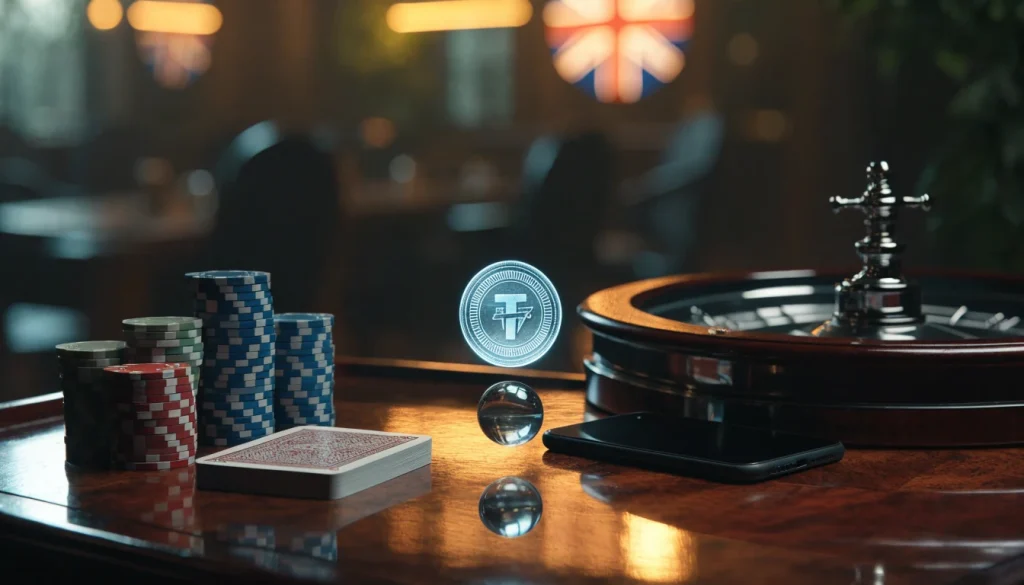
Tether availability can depend on the account, payment direction, network and bonus terms, so confirm the details before depositing.
What to check before choosing a casino that takes Tether
A page saying “crypto accepted” is not enough to treat a casino as a Tether option. I’d start in the cashier after signing in, rather than relying on a general payments page or an old review. Look for Tether by name, check whether it appears as a way to add money, and make sure the option is actually presented for your account. A broad cryptocurrency logo or a list of digital coins does not confirm that Tether is available.
That distinction matters here. A specialist review of casino payment options mentions Visa, Mastercard, bank transfer, e-wallets and several cryptocurrencies. Those are useful clues about the kinds of methods a cashier may display, but they do not establish that any particular site accepts Tether. Nor does a list of familiar methods tell you whether they are available to every customer. Treat the cashier’s current options as the practical check, not a logo on a landing page.
When you open the cashier, read the payment labels carefully. “Crypto” may cover several different assets, while a Tether option should be identified clearly enough for you to know what you are selecting. If the cashier only says that cryptocurrency is accepted, ask support which currencies can be used before you proceed. A support answer can help clear up a label, but it is still sensible to confirm that the named option appears in your own account before sending funds.
Check the surrounding information too. The cashier should make clear what the payment option is for and show the instructions that apply to it. Don’t guess that a method can be used simply because it appears in a site-wide list. Keep the distinction between a payment method being advertised and being available to you: the former is a claim; the latter is what you need to see before acting.
Ukash casinos in the UK: what payment options are confirmed
There is a separate UK point that should not be lost in the crypto discussion. If you are gambling with a remote gambling licensee serving Great Britain, it must hold the relevant UK Gambling Commission licence. I check the operator against the Commission’s public register rather than treating a polished payments page as proof of regulatory status. A licence does not tell you that Tether is accepted, of course; it answers a different question. Both checks matter, and one cannot stand in for the other.
For a UK player, the ordinary cashier options can still provide a useful comparison. Debit cards, including Visa and Mastercard, are familiar routes, while the site information described above also mentions bank transfer and e-wallets. Those names are not a promise that every route is offered at a particular casino or available to every account. They simply give you a reason to inspect the cashier closely instead of assuming that a crypto-friendly message tells the whole story.
I’d also look at the way the cashier presents its instructions before making any decision. Does it identify the payment method plainly? Are the steps clear enough to follow without guessing? Can you see the relevant terms and contact support if something is unclear? If the wording leaves you unsure what you are about to choose, pause. A deposit screen is a poor place to improvise.
A legal remote gambling operator must also prompt a new customer to set a financial limit before their first deposit and make account-level limit controls accessible. That is worth noticing while you are in the account, even though it does not confirm anything about Tether. A functioning cashier is more than a row of payment logos; it sits inside an account with the controls and information a UK customer should be able to access.
So, if you are looking for a Tether casino in the UK, begin with a modest test of the claim: sign in, open the cashier, and look for Tether specifically. Don’t turn “cryptocurrency supported” into “Tether accepted”, and don’t treat a general payment list as confirmation. If Tether is not named clearly, ask the operator before depositing. That is less exciting than a ready-made shortlist, but it is a much sounder starting point.
Do
- Sign in and check the cashier specifically for Tether
- Verify the operator holds a UK Gambling Commission licence
- Confirm the payment option is available for your specific account
Don’t
- Rely on a general “crypto accepted” logo on a landing page
- Assume a general cryptocurrency list confirms Tether availability
- Treat a polished payments page as proof of regulatory status
Recommended online casinos
- JetsetspinsBonus: 200% Bonus + 100 Free Spins + Free Royal Wheel · Payout speed: 1-3 business days
- BritsinoBonus: Welcome Package – Get your £2,200 + 2,000 FS · Payout speed: 1-3 business days
- Revery PlayBonus: 100% up to€1,000+ 100 FS · Payout speed: 1-3 business days
- WinBeastBonus: €5000 + 500 FS + €650 Freebet · Payout speed: 1-3 business days
- NightLuckBonus: Welcome Pack + 805% Up To 6400€ + 280 FS · Payout speed: 1-3 business days
- SlotoSportBonus: 500% up to £ 10 200+ 777 FS · Payout speed: 1-3 business days
- NightWinBonus: £900 + 400 free spins · Payout speed: 1-3 business days
Check payment availability and your account currency first
A payment logo on a casino’s general information page is a starting point, not a promise that the method will appear for your account. That matters if you are looking for an online casino with Tether in the UK: do not treat a mention of cryptocurrency, or a Tether label on a page aimed at a wider audience, as confirmation that you can use it. Check the cashier while signed in and look for the exact method offered to you.
Availability can depend on the account and the transaction you are trying to make. A method may be listed on a site-wide page yet not appear in your cashier. The cashier is the practical check: it shows the choices the operator is presenting for your account at that point. If Tether is not clearly named there, do not assume that another crypto option means the same thing. The asset and the payment route need to match what the cashier actually offers.
I treat broad payment lists with a bit of caution. A specialist review of casino payment options lists Visa and Mastercard, but that does not establish that either card product is currently available to every UK customer at every site. Nor does it settle whether your particular card is eligible. Check the operator’s cashier and your card details before trying to pay. A brand name on a page cannot answer those account-specific questions.
The same goes for currency. A specialist review says the supplied pages support GBP, but you should confirm the currency assigned to your own casino account before making the first transaction. A site can describe a currency option in general terms without that being a guarantee about the account you have opened. Look for the currency shown in your profile, cashier, or deposit confirmation, and make sure it is pounds if that is what you intend to use.
Casinos That Accept Ethereum in the UK: Payment Guide
This is worth checking before you send funds, not after. If the casino account is set to a different currency, the amount you see may be converted somewhere along the route. You could then be comparing a displayed balance in one currency with a bank or payment account in another. That makes it harder to know what you are authorising. Confirm the account currency first, and pause if the amount or currency shown at confirmation does not match your expectation.
For a Tether casino online, the currency question is separate from whether Tether itself is accepted. A cashier might show GBP as the account currency and still not offer Tether; it might show a crypto payment option without making clear which currency the casino balance will use. Check both details independently: the payment method and the account denomination. One does not prove the other.
I would also check the payment screen at the point you intend to make the transaction. General pages can be useful for narrowing down what to investigate, but they are not a substitute for the live choices shown to you. If the cashier lists a method only after you select a transaction type, read the details on that screen before continuing. Do not proceed on the strength of an old bookmark, a logo, or a third-party description.
If you are comparing Tether online casino sites, keep the check consistent. Sign in to each account, inspect its cashier, and note whether Tether is named explicitly and whether the balance is shown in GBP. If one detail is unclear, ask the operator before depositing rather than guessing from another site’s wording. A clear answer about the payment option and currency is more useful than a long list of logos.
Confirming Your Account
- Sign in to your casino account
- Check the cashier for the explicit Tether payment method
- Verify that the account currency is set to GBP
- Confirm the operator’s UK Gambling Commission licence status
There is a straightforward distinction here: a site can mention a payment method, but the cashier is where you confirm whether it is available to you. A page can state that GBP is supported, but your account display is where you confirm its currency. For UK players, this check should sit alongside confirming that the operator holds the relevant UK Gambling Commission licence. The payment method does not change that requirement.
Take a moment over the final confirmation screen, too. Check the method selected, the currency displayed, and the amount you are being asked to authorise. If any of those differs from what you expected, stop and clarify it with the operator. That small pause is less trouble than trying to untangle a transaction made on an assumption. A Tether online casino UK option is only useful to you when the cashier names it for your account and the account currency is clear.
Deposits and withdrawals are not always a two-way street
A deposit confirms that money has reached your casino balance. It does not, by itself, confirm how a later withdrawal will be sent. That distinction matters when you are considering a casino that appears to take Tether: the route into the account and the route back out may be governed by different checks.
For UK players, the usual expectation is that a payout goes back to the original payment source. Anti-money laundering rules are one reason for this closed-loop approach. It helps the casino check that funds are being returned to the person and source associated with the deposit, rather than sent through an unrelated route. So a payment option that works for adding funds is not automatically a cash-out option.
Echeck Casinos in the UK: How to Verify Payment Access
With Tether, check the withdrawal instructions before you deposit, not after a win. Look for the exact wording in the cashier and payment terms: does it describe withdrawals as well as deposits? Does it say that a payout must return by the same method, or that the casino may select an alternative route? If the wording is unclear, ask customer support and keep the reply. A payment logo or a successful deposit is not an answer to either question.
This is particularly worth checking if a casino advertises Tether alongside other payment choices. The list may describe ways to fund an account without promising that each one can receive a withdrawal. Nor does the label “Tether casino” tell you what happens when you ask for money back. You need the withdrawal rules for the specific account and payment option, not just a general description of the site.
The casino’s part of the payout also takes time. A withdrawal request may need internal approval before it is sent, and the payment provider or network then has its own role in delivery. Those are separate stages. A request marked as pending has not necessarily left the casino; one marked as processed may still need to reach your payment account. Read the status labels carefully rather than treating every update as proof that the funds have arrived.
A specialist casino review notes that processing may take longer on a first withdrawal while verification is being completed. That is a useful practical warning, not a promise about any particular casino’s schedule. If you have not completed the requested checks, allow for the possibility that approval will pause while the casino reviews your account. Check the operator’s stated process and timescales directly, since they can differ.
Attention: A successful deposit does not automatically guarantee that the same method is available for withdrawals due to anti-money laundering rules.
Do not plan spending around a payout until you know which stage it has reached. If you need an update, ask whether the withdrawal is awaiting casino approval, has been sent, or is still being handled by the payment service. Those questions are more useful than asking only whether the payment is “fast”. A quick deposit tells you little about the return journey.
Keep a record of the deposit method, the withdrawal terms shown at the time, and any support response. This is not about expecting a problem; it gives you something concrete to refer to if the cashier’s options or the stated route seem inconsistent later. If the casino declines a requested route, ask it to explain which rule applies and what approved route is available instead. Do not send a second payment simply to test what might work.
When assessing Tether casino sites in the UK, treat the deposit and withdrawal journey as two connected but distinct steps. The key question is not merely whether Tether can reach the balance. It is whether the site explains how eligible funds can leave, what approval is required, and where a payout is expected to go. Read that part before you commit. A one-way door is still a door.
What makes a Tether casino a better fit for you
There is no single best Tether casino in the UK for every player. A site that suits someone making a small, occasional deposit may be a poor fit if you plan to move a different amount or care more about keeping costs predictable. I would judge the actual transaction, not a headline claim about cheap or free payments.
Casinos That Accept E-Cheques in the UK: What to Check
Start with the amount you intend to send and work out what you will pay from the moment you fund the transaction to the amount credited to your casino balance. A casino charge is only one part of that calculation. The payment provider may charge separately, the conversion rate may include a spread, and the network can carry its own cost. A specialist review also points out that there is no payment method that is automatically the cheapest in every case: the comparison depends on the amount and the charges attached to that particular route.
That is a more useful test than looking for a “zero-fee” badge. It may describe one charge while saying nothing about the rate used to convert your funds or any cost elsewhere in the route. Check what you will send, what the cashier says will arrive, and whether the provider displays a separate charge before you confirm. If those figures are not clear, you cannot make a sound cost comparison. Dry, but important.
For a Tether slot or other casino games, the payment route should fit the way you actually handle money. If you already hold USDT, consider whether the cashier’s stated charges and conversion treatment make sense for the amount you plan to move. If you would need to exchange funds first, include that step in your own comparison rather than treating the casino deposit screen as the whole cost. Do not assume that the label “USDT” means every stage is free.
Total transaction costs include casino charges, payment provider fees, network costs, and potential conversion spreads.
I would also separate a low-cost route from a route you can use comfortably. A small apparent saving may not matter if the total is hard to calculate before sending funds. On the other hand, a clear breakdown lets you compare options without guessing. Look for the amount deducted, the amount credited, any provider charge, and the exchange rate applied. Keep a record of the figures shown at confirmation so you can compare them with the completed transaction.
No ranking can settle this for everyone, and a list of supposed best USDT casinos would be little use without reliable, current figures for the same transaction. The best fit is the site where the cashier clearly states the payment terms and the total cost works for your own use. Treat “best” as a comparison you can check, not a promise attached to a Tether logo.
Using Tether at an online casino: compare the other routes too
Tether is only useful as a casino payment option if the cashier offers it for your account and transaction. It is worth comparing it with familiar UK routes before deciding how to fund an account: a method’s name can sound straightforward, but the deposit and payout experience may differ.
Debit cards, including Visa and Mastercard, are commonly accepted at UK casinos. A specialist review describes card deposits as potentially instant, while a payout can take several business days. That gap matters if you are judging a route by how quickly money leaves your bank: the deposit time tells you little about how quickly winnings reach you.
Open banking and bank transfers are another point of comparison. A specialist review reports that these can give instant deposits and fast withdrawals at many sites. The wording matters: availability and performance vary by casino, so treat this as a possibility to check in the cashier and payment terms, not a promise for every account. Bank transfer may suit you if you prefer to pay directly from a bank account, but do not assume that its deposit and withdrawal stages follow the same timetable.
Casinos That Accept Interac in the UK: Payment Guide
For a UK USDT casino, make the same distinction. Confirm what the cashier actually permits, then look separately at the stated process for getting money out. A quick crypto deposit would not, by itself, establish that a withdrawal is equally quick or handled through the same route. Payment options can be presented neatly on a site; the practical details are in the transaction rules.
I compare routes by what I need them to do. If I want a familiar way to pay from a bank account, I check the debit-card and bank-transfer options shown to me. If I am considering Tether, I check that it is genuinely available for my account and read the payout information before choosing it. That is more useful than treating lists of the best Tether online casinos as proof that a particular method will work for every UK player.
There is no single route that wins on every measure. Cards may make the deposit feel immediate, but the cash-out can take longer. A bank route may be described as fast for both stages at some sites, yet the casino’s own process still matters. Tether should be compared on the terms actually displayed, not on assumptions drawn from another payment method.
Casinos That Accept Zimpler in the UK
Keep the comparison practical: what can you use to deposit, what does the casino say about withdrawals, and does the route suit the way you want to pay? A method that looks quick at the first step may be less appealing when you consider the full journey. Deposit speed is only half the story.
Keep deposits and withdrawals tied to the same account
When you deposit, use an account in your own name and keep the details consistent. That gives the casino a clearer link between you, your account and the payment route. In my experience, this is the simplest way to avoid basic ownership questions turning into extra steps when you ask for a payout.
The same principle matters if you use Tether at a casino. Keep a record of which account and route you used, and check that the details you provide to the casino match the account you control. A Tether casino site may have its own checks, but consistency gives staff less reason to pause while they work out who owns the funds.
Casinos That Accept Citadel in the UK: What to Check
Casinos may return money to the original payment source as an anti-fraud and anti-money-laundering control. If you ask to receive it somewhere else, expect the operator to establish why that route belongs to you. That can mean providing more information or completing additional verification. It is not necessarily a sign that anything is wrong; the alternative route simply needs to be checked.
Avoid switching between accounts belonging to different people, even if you trust them. A payment made from someone else’s account can make it harder to confirm that the deposit and the player are connected. If your usual route is unavailable, contact the casino before choosing another one rather than assuming it will be accepted for Tether casino withdrawals.
This is about keeping the ownership trail straightforward, not finding a clever workaround. For a casino with Tether UK players can access, I would look at the named account used for the deposit and keep the withdrawal request aligned with it. The fewer unexplained changes, the less there is to untangle.
A practical check before depositing: make sure the casino account and payment account use your own matching details, and save any transaction confirmation. If a payout later needs to go through a different route, ask support what evidence they need before submitting the request. That is less frustrating than discovering the mismatch after the casino has started its checks.
Keep it simple.
Crypto payment costs can hide in the exchange rate
When you look at a Tether option at a crypto casino, the fee shown beside the deposit is only one part of the cost. A specialist review identifies several possible charges around a payment: the casino may charge one, a payment provider may add another, and your bank or card issuer may have its own fee. With USDT, conversion can matter too. The figure that looks like a small flat charge may not tell you what the transaction costs overall.
I compare the amount that leaves my account with the value credited to the casino balance, then check what happens when funds move back. That gives you a more useful picture than reading a single fee label. Keep the amount and currency consistent in your comparison; otherwise, it is easy to mistake a conversion difference for a payment charge.
Network Mismatch
Sending funds via an incompatible network (e.g., sending ERC20 to a TRC20 address) may result in the loss of your funds.
The exchange rate deserves particular attention. A conversion spread is the gap between the rate applied to your transaction and a reference rate. It may not appear as a separate line on the cashier screen, yet a specialist review notes that this spread can cost more than a visible flat fee. In other words, “no deposit fee” does not necessarily mean no cost. Dry, but worth remembering.
For a Tether crypto casino, check whether the displayed balance is credited in USDT or converted into another currency, and whether a separate conversion happens when you fund or cash out. Read the provider’s rate details as well as the casino’s fee wording. If the rate is not shown until you confirm, pause and find out how the final amount is calculated before approving the transfer.
Possible charges can come from different parts of the route: the casino, payment provider, bank or issuer, exchange-rate spread, and network fees. These are not automatic charges on every transaction; they are places where a cost may arise. The relevant question is which ones apply to your payment and how they affect the amount received.
I would not call one route cheaper just because its fee box is blank. Compare the full cost for the same transaction amount, including any rate adjustment, and keep a record of the amount sent and credited. That is the comparison that counts.
TRC20 or ERC20? Confirm the network in the cashier
Tether can appear as USDT on different blockchain networks. TRC20 and ERC20 are network labels, not two different ways of spelling the same deposit option. For a transfer to reach your casino balance, the network selected in your wallet must match the one shown for that transaction in the cashier.
Casinos That Accept Maestro in the UK: What to Check
I would check this at the point of deposit, not rely on a general payments page or an old review. A site may mention cryptocurrencies without naming which tokens or networks are currently available to a UK account. A specialist review can be a useful starting point, but the cashier is where you need to confirm the actual option before sending anything.
Open the deposit screen and look for Tether or USDT. If it is offered, check whether the cashier explicitly identifies TRC20, ERC20, or another network. Then compare that choice with the network selected in the wallet you plan to send from. An address generated for one network should not be treated as suitable for another just because both transfers involve USDT.
The same check applies in reverse if you are preparing a withdrawal: read the casino’s instructions and make sure the receiving wallet can accept Tether on the stated network. Do not assume that a Tether TRC20 casino option means ERC20 will work as well, or that a casino showing one network will provide the other for a later transaction.
Before confirming, review the token, network and destination address on both sides. If the cashier provides additional instructions, such as a reference field, follow them exactly. If the network is unclear, or the casino and wallet show different choices, stop and ask the operator for clarification rather than guessing. A transfer sent using an incompatible network may not appear in your balance, and recovery is not something to count on.
That small pause matters more than the label in a headline. A casino advertising USDT is not necessarily offering every USDT network. Check the live cashier details for your account and transaction, then proceed only when they match.
Final Checks
- Match your wallet network (TRC20/ERC20) exactly with the casino cashier
- Check the full bonus terms to see if Tether deposits are eligible
- Verify the site’s licence on the public register regardless of “no KYC” claims
- Compare the total cost, including exchange rate spreads, before depositing
Tether deposits, casino bonuses and the small print
A Tether deposit does not automatically qualify for a casino promotion. The offer may depend on the payment method you select, and the terms can treat crypto payments differently from cards or other options. Before sending USDT, open the bonus rules and check whether Tether is eligible for that specific offer. A banner on the home page is not the rulebook.
For a welcome bonus or deposit bonus, look for the eligible payment methods, how the offer is activated and what happens if you deposit using a method that is excluded. Check whether opting in is required, too. If the terms are unclear, ask the operator before depositing; once the transaction is made, you may not be able to change which promotion applies.
A no-deposit offer has its own conditions. Confirm who can claim it, whether it is available to new customers and whether any payment method must be used to qualify. Do not assume that a no-deposit bonus means no restrictions, or that it will be available simply because you have a Tether wallet. The offer’s wording matters.
Payment exclusions are not limited to crypto. A specialist review reports that PayPal may be excluded from bonus eligibility, while Skrill and Neteller are often left out of promotions at some sites. Treat those as details to verify against the operator’s current terms, not as a rule that applies everywhere. Payment rules and promotions can change.
I would also check what the bonus requires before accepting it: which games count, when the offer expires and what restrictions apply to withdrawing winnings. Those details can matter more than the headline amount. If Tether is excluded, decide whether the promotion is worth using another eligible method; do not switch payment routes without checking the casino’s rules.
A search for an anonymous Tether casino or a USDT casino bonus can turn up bold claims, but the label alone tells you little about the offer. Read the promotion page and the full terms on the site you plan to use. If the wording does not say plainly whether Tether qualifies, get confirmation first. That is less exciting than a banner. It is also clearer.
Casinos That Accept Neosurf in the UK: Payment Guide
No-KYC claims do not remove payout checks
A “no KYC” label can sound like a promise that you will never be asked to verify your identity. I would read it more narrowly: it may describe how a site presents its sign-up or deposit process, not what will happen when you request a withdrawal. A Tether or USDT payment does not, by itself, settle that question.
For a UK player, the distinction matters. Remote gambling licensees serving Great Britain must hold a UK Gambling Commission licence, and a legal online casino must be licensed. Do not treat a marketing claim about a no-verification Tether casino as proof that payout checks cannot apply. Check the operator’s terms and its withdrawal information before depositing, and confirm the site’s licence on the Commission’s public register.
A withdrawal can involve more than sending funds out. The casino has an internal approval stage, and whether your account is fully verified can affect how long that stage takes. A specialist review also notes that a first withdrawal may take longer when verification is still being completed; that is a reported possibility, not a timetable to rely on. The operator’s own process is what matters for your account.
If you have not completed verification, check what the casino may ask you to provide and how to submit it before you play. Keep an eye on account messages as well as the cashier: a pending payout may need your response before it can move forward. If the terms say checks can happen at withdrawal, assume the “no KYC” wording does not cancel that condition.
The practical test is simple: can you find a clear explanation of verification and withdrawal approval, rather than just a bold sign-up claim? If not, I would not count on a Tether casino with “no verification” marketing as a route to an unchecked payout. The label is not the process.
What is the fastest withdrawal method for UK casinos?
PayPal, open banking and debit cards linked to fast payout systems are generally among the quickest options. The casino’s approval process and your verification status also affect how soon you receive the money.
Do UK casino withdrawals require verification?
You may need to complete verification, particularly before a first withdrawal. An account that is not fully verified can slow down processing.
Why can a fast payout casino still delay my withdrawal?
The casino must approve the withdrawal, and it may take longer if your account needs verification. First withdrawals can be delayed while those checks are completed.
Are fast casino withdrawals guaranteed?
No. The time depends on the casino’s approval process and whether your account is fully verified; bank transfers can also be affected by cut-off times and weekends.
Why must withdrawals return to the deposit method?
Returning funds to the original payment source is a common anti-fraud and anti-money-laundering control. Using a different route may mean additional verification.